High-Frequency Communication
Phased arrays, microstrip and dielectric antennas, RF front ends, anti-jamming architectures, software-defined radio and RF energy harvesting.
HARRAN UNIVERSITY · ELECTRICAL & ELECTRONICS ENGINEERING
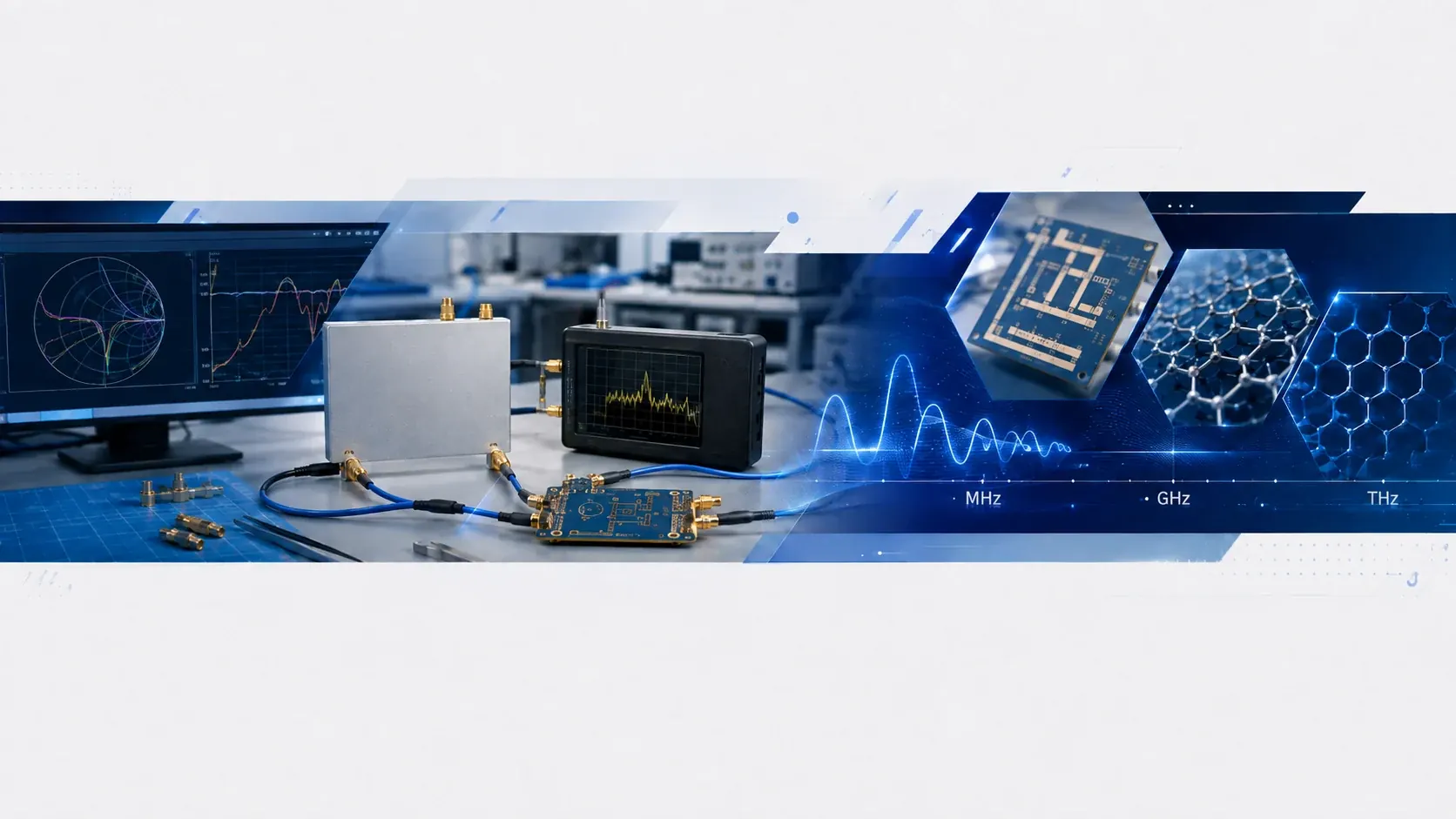
Research in applied electromagnetics from RF and microwave frequencies to emerging THz systems.
The Applied Electromagnetics Lab develops research in high-frequency communication, electromagnetic sensing, computational electromagnetics, and signal intelligence, with an emphasis on physically grounded modelling, measurement, and reproducible analysis.
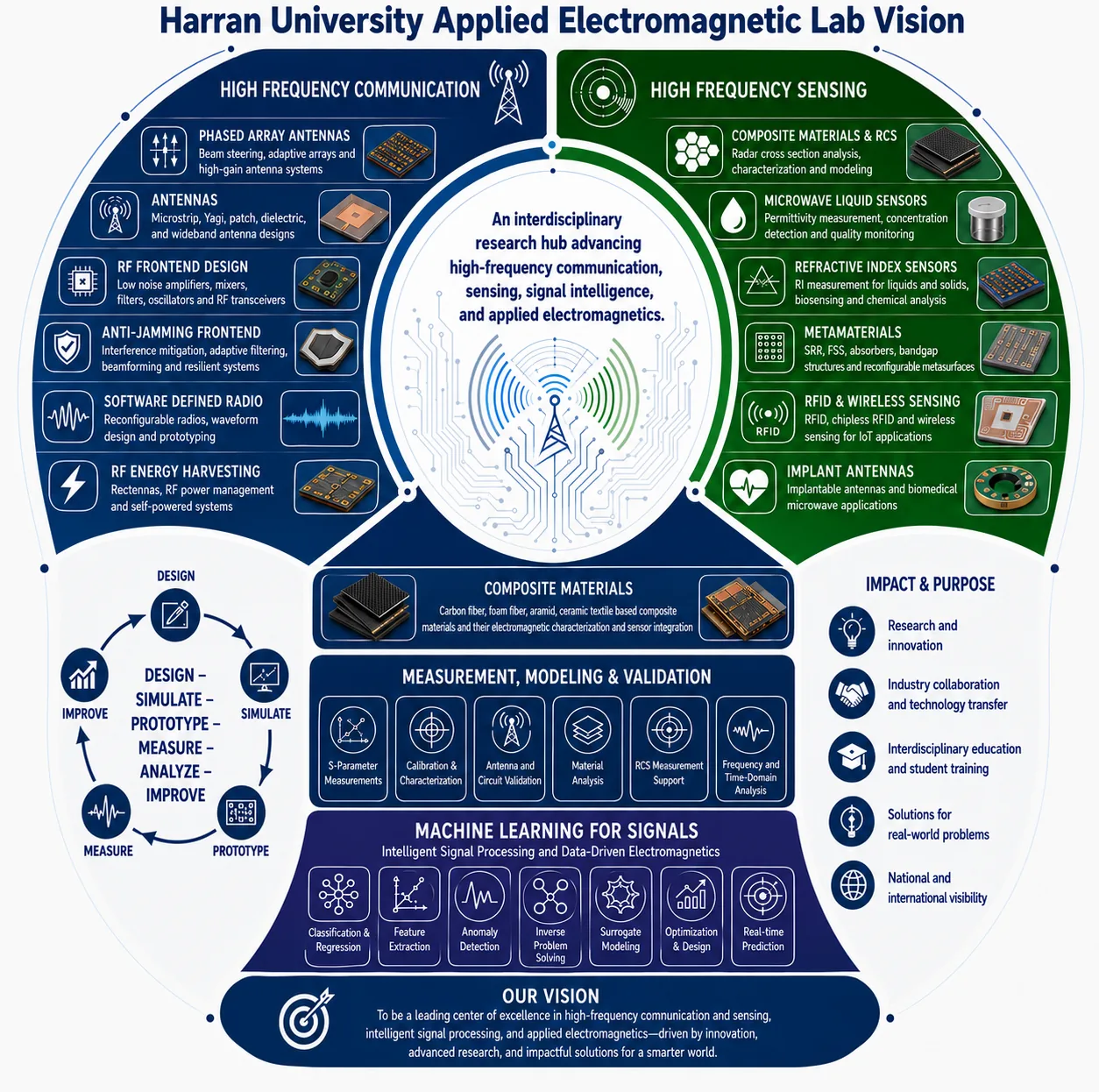
Lab vision
The laboratory vision integrates high-frequency communication and sensing with materials, measurement, validation, and machine learning for signals. The objective is to connect electromagnetic mechanisms with measurable, reproducible, and interpretable engineering outcomes.
Research lead
Assistant Professor · Lab Lead & Principal Investigator
Electrical & Electronics Engineering · Harran University
Academic & professional profiles
Research areas
Research is organized around electromagnetic hardware, sensing mechanisms, computational modelling, and the interpretation of measured and simulated signals. Each domain connects to concrete project pages and research outputs.
Phased arrays, microstrip and dielectric antennas, RF front ends, anti-jamming architectures, software-defined radio and RF energy harvesting.
Microwave liquid and refractive-index sensing, RFID sensing, metamaterials, composite characterization and biomedical electromagnetic concepts.
Full-wave simulation, material modelling, geometry transformation, surrogate modelling, optimization and inverse electromagnetic problems.
Feature extraction, classification, anomaly detection, uncertainty-aware analysis and physics-guided interpretation of electromagnetic measurements.

Active research projects
Each project page separates the research question, electromagnetic mechanism, measurement or simulation workflow, expected evidence, and related scholarly outputs.
How can multi-resonant electromagnetic responses improve material and state estimation beyond a single frequency shift?
Project page →Can passive electromagnetic signatures distinguish structural degradation, cracks, strain, and other state changes with low-complexity interrogation?
Project page →How can tunable resonators and graphene-enabled structures produce interpretable refractive-index sensing signatures?
Project page →How robust are antennas, interconnects, and resonant structures when bending, twisting, and combined deformations alter their geometry?
Project page →How should waveguide, resonator, and free-space methods be selected and validated for practical dielectric extraction?
Project page →How can field physics, simulation, uncertainty, and data-driven models be combined without losing physical interpretability?
Project page →Technical capabilities
Capabilities are separated by maturity so that experimental availability, active research, and method development are explicit rather than implied.
| Capability | Method / platform | Typical regime | Primary outputs | Status |
|---|---|---|---|---|
| S-parameter measurement | Vector network analyser with calibration and fixture-aware workflows | RF / microwave | S11, S21, magnitude, phase | Available |
| Resonant sensing | Resonators, fixtures and controlled perturbation | Microwave | Resonant frequency, Q-factor, bandwidth, multi-feature response | Active |
| Dielectric / material characterization | Waveguide, resonator and free-space strategies selected by specimen and band | Method dependent | Relative permittivity, loss tangent, uncertainty-aware estimates | Developing |
| Antenna & RF validation | VNA, SDR and compact application-specific arrangements | RF / microwave | Matching, coupling, spectral response, system metrics | Available |
| Computational electromagnetics | Full-wave numerical modelling, geometry transformation and parametric studies | RF → THz | Fields, S-parameters, sensitivities, deformation response | Active |
| Signal intelligence | Python-based feature engineering, machine learning and statistical validation | Measured / simulated data | Classification, inference, uncertainty and benchmark metrics | Active |
Measurement method and frequency range depend on the device, material, fixture, calibration strategy, specimen dimensions, and required uncertainty. Project-specific feasibility is assessed before experimental work.
Research outputs
Selected papers are summarized by the technical problem they address and the contribution they make. DOI links point to the publication record.
Selected publications by the Lab Lead
Sensing and Imaging · 27(1) · Article 62
Problem: tunable and polarization-tolerant refractive-index sensing at terahertz frequencies. Approach: graphene-enabled dual elliptical-ring metasurface with full-wave analysis of resonance physics. Contribution: links tunability, field/current interpretation, and sensing response in a compact numerical platform.
Optical and Quantum Electronics · 58 · Article 181
Problem: interpreting tunable THz resonance signatures for sensing. Approach: nested split-ring/graphene full-wave modelling with S-parameter feature construction and benchmarked classification. Contribution: couples electromagnetic response analysis with a comparative supervised-learning stage.
Harran University Journal of Engineering · 10(3) · 172–183
Problem: deformation-sensitive RF behaviour in lightweight conformal structures. Approach: numerical characterization of a PDMS-based flexible interconnect incorporating a defected-ground split-ring resonator. Contribution: evaluates bending-related electromagnetic response for high-frequency sensing concepts.
IEEE Transactions on Antennas and Propagation · 71(6) · 4714–4723
Problem: realistic antenna deformation is more complex than simple cylindrical bending. Approach: Green-Coordinates-based spatial manipulation generates spherical, saddle, and twisting deformations for full-wave analysis. Contribution: assesses antenna performance robustness under complex in-situ geometric changes.
IEEE Transactions on Antennas and Propagation · 70(8) · 6377–6387
Problem: standard EM workflows struggle to generate arbitrary bent, twisted, and crumpled antenna geometries robustly. Approach: Green Coordinates with distortion compensation. Contribution: provides a systematic route from complex spatial deformation to EM-ready antenna geometry.
Software & data
Public code and future open research software are released through the lab GitHub organization. Individual tools are cited only when a repository is publicly available.
Open GitHub ↗Measurement and simulation datasets are being structured around provenance, calibration context, physical parameters, and reusable benchmark splits.
Benchmark protocols are being developed to connect electromagnetic features, uncertainty, model comparison, and physically interpretable validation.
Research updates
Updates point to a publication, project page, or concrete site resource rather than functioning as a general-purpose blog.
The lab site now connects research areas to dedicated project pages, maturity-labelled capabilities, and publication evidence.
Explore projects →A numerical terahertz refractive-index sensing study was published in Sensing and Imaging.
Publication DOI ↗A graphene-enabled nested split-ring study combining electromagnetic response features with classifier benchmarking was published in Optical and Quantum Electronics.
Publication DOI ↗Numerical characterization of a PDMS-based flexible RF interconnect with a defected-ground split-ring resonator was published.
Publication DOI ↗Academic biography
Assistant Professor of Electrical and Electronics Engineering · Harran University, Şanlıurfa, Türkiye
Dr. Ekrem Altınözen works at the intersection of computational electromagnetics, RF and microwave engineering, resonant sensing, antenna technology, and intelligent signal interpretation. His research combines electromagnetic theory, full-wave numerical simulation, experimental measurement, inverse modelling, and data-driven analysis.
His doctoral research at the University of Nottingham developed spatial-warping methods for representing complex deformations in flexible electromagnetic structures. Current work extends these foundations toward microwave and terahertz resonant sensors, chipless RFID, material characterization, structural sensing, reconfigurable electromagnetic structures, and physics-guided signal intelligence.

Student research & opportunities
Undergraduate and graduate students interested in RF, microwave sensing, antennas, SDR, computational electromagnetics, or signal processing may participate through supervised research projects when suitable topics and laboratory capacity are available.
Research inquiry →Acknowledgements & support
Laboratory equipment support is acknowledged separately from complimentary samples, materials, software access, and development platforms.
We gratefully acknowledge the support of companies that contribute to our lab by providing low-frequency Digital Multimeters, Waveform Generators, InfiniiVision 1000 X-Series Oscilloscope, and a DC power supply with three outputs.


We gratefully acknowledge the support of companies that contribute to our lab by providing complimentary samples and development boards.





Contact & collaboration
The laboratory welcomes research collaborations that connect electromagnetic modelling, sensing, RF hardware, materials, measurement, and intelligent signal processing.